Retaining wall failure usually begins long before a wall collapses. Early warning signs include leaning, bulging, cracking, blocked weep holes, movement in paving above the wall, or water collecting behind it. In many cases, the cause is not the wall material itself but poor drainage, inadequate design, missing reinforcement, weak foundations or surcharge loads that were never allowed for.
Retaining walls are deceptively simple structures. A wall holds back soil — how hard can it be? Yet across three decades of assessing subsidence and ground-movement claims, retaining wall failures remain one of the most common, and most preventable, problems we encounter. Almost all of them trace back to a handful of recurring causes.
What are the early signs of retaining wall failure?
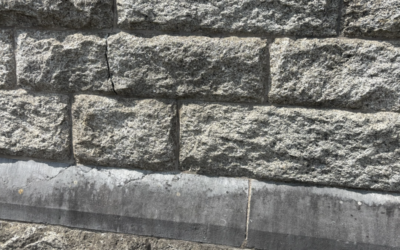
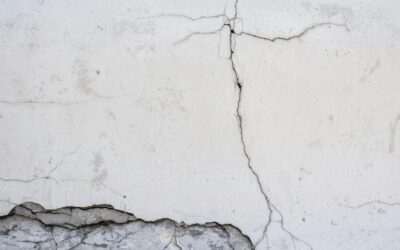
A retaining wall should be inspected if it is leaning, rotating, bulging, cracking or separating at the joints.
Other warning signs include:
- water staining
- blocked weep holes
- soil washing out from behind the wall
- movement in nearby paving or driveways
- cracking in nearby buildings or boundary walls
The risk is greater where the wall retains a driveway, parking area, embankment, school ground, garden terrace or land close to a building. Walls that have performed adequately for years can begin to move when drainage fails, when additional loads are introduced, or when nearby ground conditions change.
Poor drainage and hydrostatic pressure
The single greatest enemy of any retaining wall is water. Soil allowed to saturate behind a wall exerts far greater lateral pressure than drained soil, because hydrostatic pressure is added to the earth pressure.
Walls that perform well are those that allow water to escape in a controlled way — through weep holes, a granular drainage zone and, behind embankments and around sports pitches, properly installed relief and land drains.
When these measures are reduced, omitted or left unmaintained, pressure builds behind the wall until it slides, rotates, cracks or bulges. We frequently find drains that were never installed, were undersized, or have long since blocked through lack of maintenance.
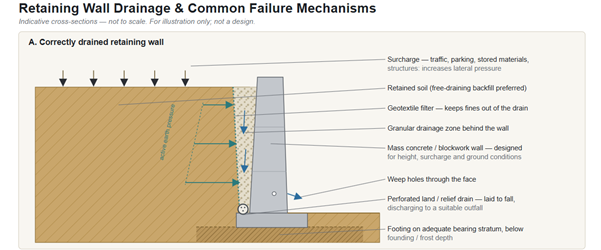
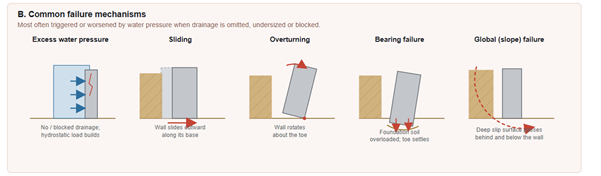
Diagrams of retaining wall drainage and failure mechanisms
Proprietary retaining wall systems built incorrectly
Modular and segmental block systems — the kind widely used to retain embankments and surround sports pitches — are engineered products. They work only when built as the manufacturer intends.
The recurring problem is rarely the blocks themselves but the way they are installed. Common departures include omitting the geogrid soil-reinforcement layers that give a reinforced-soil wall its strength, leaving out the connectors or restraints between courses, using the wrong backfill, and skipping the specified drainage aggregate.
Strip those elements out and a system designed to act as reinforced soil is left behaving as a simple gravity wall it was never sized to be — and it fails.
Retaining walls built without engineering design
A large proportion of failed walls were never designed at all. Blockwork and mass concrete walls are often built to a builder’s rule of thumb, with no calculation of the retained height, surcharge or ground conditions they must resist.
Mass concrete relies on its own weight to resist overturning and sliding. If it is too narrow or founded on poor ground, it moves. Unreinforced or lightly reinforced blockwork has very little capacity to resist the bending forces from retained soil.
Add a surcharge that was never considered — vehicles, plant, stacked materials, extensions, parking areas or spectators close to the wall — and an already marginal structure can be pushed beyond its limit.
Weak foundations, made ground and slope instability
Foundations placed on made ground, the absence of any check on overall slope stability, and a lack of maintenance all compound these issues.
The pattern is consistent: retaining wall failures arise where design, drainage and the manufacturer’s requirements are treated as optional rather than essential.
The same lessons at home, at school and at work
These are not problems confined to embankments and sports grounds. Exactly the same mechanisms appear in everyday residential and commercial settings.
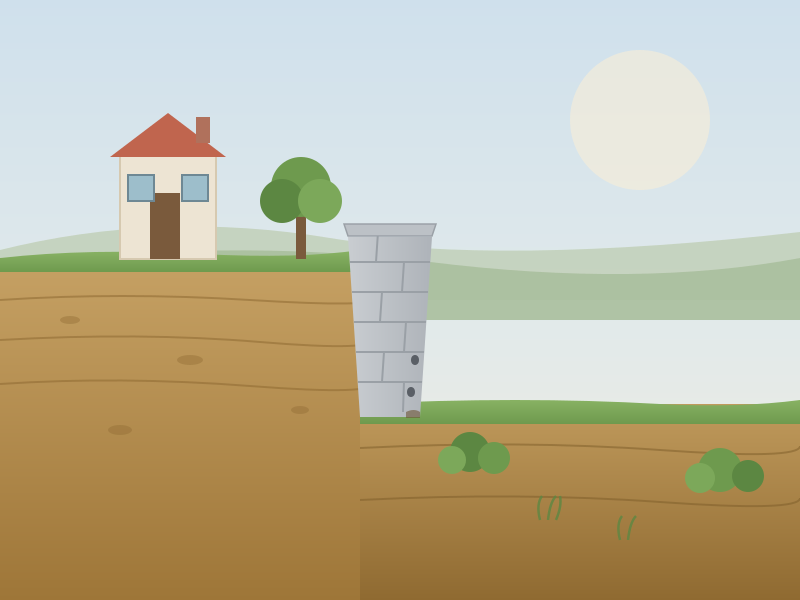
Houses on sloping sites often rely on retaining walls to hold up a garden, a driveway, a building platform or a neighbour’s higher ground. Many of those walls are older structures with no design records, no drainage and no certainty over who owns or maintains them.
Split-level extensions, terraced gardens and walls supporting a parking area above the house are recurring trouble spots, because the surcharge from vehicles or the structure itself is rarely allowed for.
Schools, care homes, retail units and offices face the same issues at larger scale: landscaped slopes, car parks cut into a hillside, and boundary walls retaining adjacent higher ground, often close to areas used by children, residents or the public.
Here the consequence of failure is not only the cost of rebuilding the wall but the risk to the building it protects and to the people nearby.
Can retaining wall failure cause subsidence?
A retaining wall that loses its drainage and begins to lean can redirect water and ground movement towards a dwelling or commercial premises. In some cases, the first visible symptom may be cracking in the building, movement in paving or distortion around doors and windows.
That movement may be mistaken for subsidence, may contribute to localised foundation movement, or may reveal a wider ground-stability problem. For that reason, the wall, retained ground, drainage routes and nearby structures should be considered together rather than inspected in isolation.
When should a retaining wall be inspected by an engineer?
A retaining wall should be inspected by a suitably qualified engineer if it is leaning, cracking, bulging, retaining land near a building, supporting a driveway or car park, showing signs of poor drainage, or located where failure could endanger people.
The underlying message is the same whether the wall surrounds a pitch or holds up a back garden: a retaining wall is a load-bearing structure, not a piece of landscaping, and it deserves to be designed, drained and maintained as one.
If you are responsible for a retaining wall — whether it supports an embankment, a school site, a commercial property or a home on a slope — the most valuable step is to have it appraised before, rather than after, it shows serious signs of distress.
Need a retaining wall inspected? Contact us for an engineer-led appraisal of retaining wall movement, drainage problems, ground movement and related subsidence risk.
Disclaimer
This article is general information based on commonly observed causes of retaining wall failure. It is not a substitute for site-specific advice, and no liability is accepted for reliance on it. Any retaining structure giving cause for concern should be inspected by a chartered engineer familiar with the particular site and ground conditions.