
Underpinning Design
Foundation underpinning solutions are generally sought where the use or safety of a building is or is likely to be compromised by excessive ground movement, usually as a result of changes to the supporting soil.
What is underpinning?
Underpinning is a type of remedial work employed to strengthen and stabilise the foundation of an existing building that transfers the load of a building onto more stable ground.
Where existing foundations are inadequate, they can be repaired or improved by a process known as underpinning. This involves providing new foundations or extending the defective foundations down to more stable ground at a lower level. The use of underpinning as a solution for subsidence has increased greatly since the 1970s.
When is underpinning required?
Foundation underpinning solutions are generally sought where the use or safety of a building is or is likely to be compromised by excessive ground movement (Subsidence), usually as a result of changes to the supporting soil.
The type of house underpinning required will depend on the type of soil present and the existing foundations, and should only be specified by a suitably qualified engineer. PKT Consulting Engineers can provide a specific underpinning design solution to prevent ongoing movement in a structure.
Where there is relatively severe damage and no other options to halt the downward movement or mitigate the cause of the damage, underpinning is often the correct solution, and it should be designed and installed without delay.
What are the benefits of underpinning?
- Undeprinning is an adaptable solution for buildings suffering from subsidence. Many different underpinning options can be utilised to solve the specific issues that can vary for each property in distress.
- The structure after underpinning should arrest the current subsidence issue and will be protected from future subsidence.
- Once a property has been underpinned and certified by a chartered engineer, this will generally raise its value compared to its value before the required structural works.
- Properties suffering subsidence that have not been underpinned have a less available pool of buyers as banks may be reluctant to fund the property purchase.
- Property once underpinned correctly will offer a safer environment for those living or working there.
How much does underpinning cost?
A cost-effective underpinning system is decided upon when the ground conditions are assessed through ground investigations. Factors like access, age of building, superstructure loads, depth to stable ground, etc., are some of the factors that will be considered when designing and pricing an underpinning solution.
How does underpinning work?
Underpinning has several applications, including increasing the bearing resistance of the foundations before refurbishment, increasing the loading on a building by adding an additional floor, and preventing the undermining of existing foundations by nearby excavations. The most common method is to repair buildings affected by downward foundational movement.
The main five underpinning types are:
- Mini-piling
- Pile and beam
- Piled raft
- Mass concrete
- Pier and beam
Common underpinning methods
Mass concrete underpinning
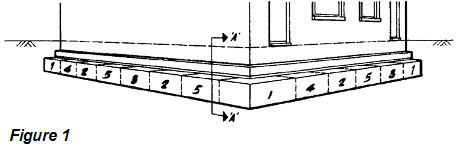
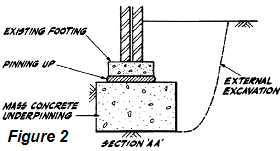
This involves excavating adjoining bays beneath the existing foundation in a sequence, filling the excavations with concrete, and then filling the small gap between the old and new foundation with non-shrinkable material (See Figure 2). The sequence is indicated by the numbers in Figure 1 below.
Pile underpinning
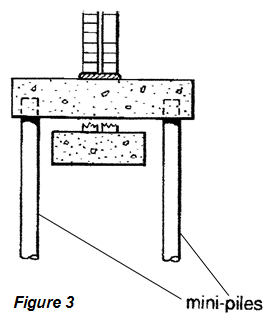
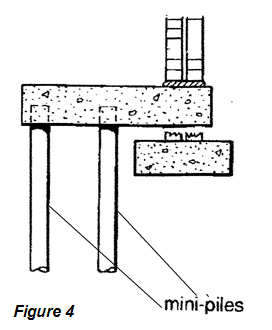
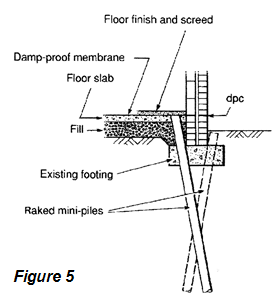
Vertical piles are installed on either side of the wall, their heads are connected by casting a concrete needle beam that passes through the wall (see Figure 3). An alternative variation of this type is a cantilever beam used instead of the needle beam, which eliminates the need for piling inside the building (see Figure 4). Alternatively, inclined mini-piles can be installed through holes drilled in existing foundations (see Figure 5).
Raft underpinning
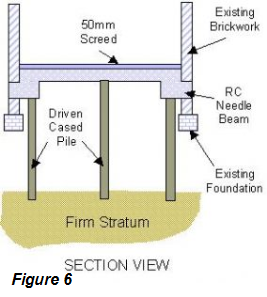
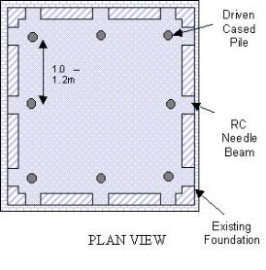
Mini-piles are installed within the property, and a reinforced concrete raft is cast integrally with the piles. Needle beams extend out from the slab into the walls below ground level to support them (See Figure 6).
What is resin injection underpinning?
Resin injection underpinning is advertised as a quick, non invasive fix to subsidence. However, it comes with many issues. Resin is less predictable in deep fill soils, peat, or water-bearing ground, and many guarantees have important exclusions, such as problems caused by groundwater or if resin spreads into drains or neighbouring land. You should always consult independent engineers such as PKT, to review the ground conditions and recommend the best long term solution.
Find our more here: Resin Injection vs Mini Piled Underpinning.
What are underpinning alternatives?
Sometimes mitigating the cause of the movement can be an alternative, e.g., using gabions to stabilise a slope or repairing leaking drains.
Before putting a building on a site which has known poor ground, the following can sometimes be options:
- Excavating the poor soil and refilling
- Vibration stone columns
- Drainage removal or addition based on ground conditions
- Soil mixing, e.g., admixtures
- Grouting